


Healthcare Leadership
Future-Proof Your Career
Upcoming Round Deadline:Invalid liquid data. Limited seats available. Reserve your spot today!
Programme Goals
Increase awareness of your leadership behaviours using a validated instrument
Understand the key behaviours of transformational leaders, and their impact on others
Improve the effectiveness of your communication as a healthcare leader
Learn frameworks and strategies to make better decisions in healthcare organisations
Examine challenges of and best practices for teamwork in healthcare
Develop constructive feedback and coaching skills to manage talent in healthcare
Learn and apply approaches to manage conflict
Integrate the above lessons to effectively engage and lead change with healthcare and non-healthcare stakeholders
Lead the Future of Healthcare. Your Learning Journey Starts Here

Programme Highlights

Comprehensive programme design, covering all the 3 core pillars of Leadership in Healthcare

Asynchronous learning via 100+ video lectures

Use of 3 case studies and 16 real-world examples for applications of conceptual frameworks

Intensive learning via 10+ assignments and frameworks

3 live sessions with faculty

1 leadership tool

Opportunity to connect with healthcare professionals/leaders across the global and healthcare value chain via 5+ discussion boards

Capstone project
Programme Modules
Module 1: Leadership Transformation in Healthcare: Dimensions, Behaviours and Competencies
Features:
Uniqueness of leadership in healthcare (What’s so different about Healthcare?)
Difference between leading and managing
Why does leadership matter
Transformational leadership using the 360° Tool.
Module 2: Skillful Communication in Healthcare: Why Does it Matter?
Features:
Fundamentals of Effective Communication
Communicating more effectively
Verbal and Non-Verbal Communication
Structuring messages for clarity and flow
Applying Ethos, Pathos and Logos
Module 3: Making Better Decisions in Healthcare: Frameworks and Strategies
Features:
Analysing decision options
Systematic approach
Problem solving using system linkages
Linking individual actions with systems impact
Multifaceted Impact Measurement
Examining execution of decisions
Module 4: Influencing, Persuading and Exercising Power: Tactics for Healthcare Leaders
Features:
Origins of power
Understanding Power, Reward Power, Coercive Power, Referent Power, legitimate power and Expert Power
Practice influencing without authority: Principles of Persuasion
Using leverage for greater influence: Principles of Leverage
Module 5: Managing Conflict in Healthcare Organisations: Approaches and Models
Features:
Different conflict styles
Conflict At work: The Classic Model
Approaches to Conflict
Are conflicts necessarily bad
Module 6: Building Effective Teams in Evolving Healthcare Setup: Challenges and Opportunities
Features:
How to improve team functioning through design and structure
Sustaining Team Performance and Learning
Benefiting from Diversity and Inclusion
Teamwork with cultural Intelligence
Module 7: Leading Healthcare Talent: Advancing Performance with Constructive Feedback and Coaching
Features:
Effects of professional training and identity
Developing and Coaching
Giving Feedback
Managing Performance
Module 8: Engaging Stakeholders in a Healthcare Setup: Collaboration for Change
Features:
Understanding stakeholders: Perspective taking
Stakeholder engagement
Stakeholder Mapping
Fostering trust to implement change together
Module 9: Dive Deeper into Diversity - Faculty Live Session
Salient Features:
Origins of diversity – individual and social.
Aspects of diversity such as its cultural roots, visible and hidden diversity
The difference between the two individual and social diversity
Module 10: From Diversity to Equity & Inclusion
Features:
Different organisational approaches to inclusion and equity
Critical evaluation of approaches to equity
Capstone Project
Toward the end of the programme, you will demonstrate your newly gained leadership skills by applying what you learned to a real-world healthcare issue/problem.
Real-World Examples

Covid-19 in Brazil

NUHS and Medicine Family Clinic Partnership

Dr Devi Shetty – Narayana Hrudyalaya – India

Vaccine Confidence Project

NUHS
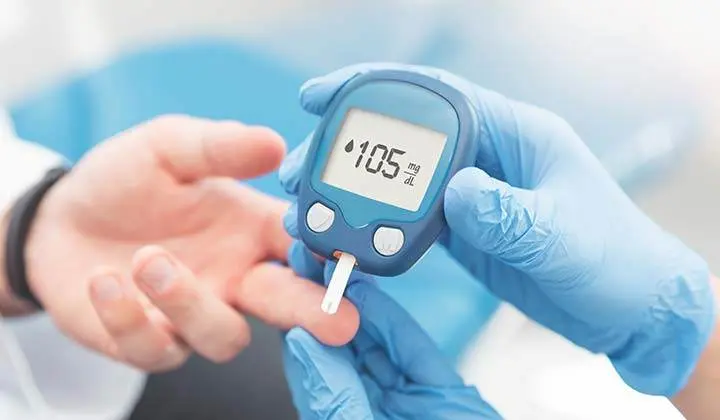
Diabetic Care Measures

Drug Resistant Tuberculosis Emergence

Emergency Department Wait Time

Dr Reddy’s Heart Polypill
Note: All brand, product and company names are trademarks™ or registered® trademarks of their respective holders. Use of them does not imply any affiliation with, endorsement by, or association of any kind between them and programme owners.
Case Studies

Duke-NUS Graduate Medical School: Educational Transplant
The case illustrates the effort of Duke-NUS Graduate Medical School's pioneering faculty in transplanting the U.S Duke University School of Medicine curriculum to the Singapore context, where the British style of medical education had been dominant. The case examines the challenges, skepticism, and eventual support from both internal and external stakeholders.

The Zuellig Family Foundation: A Bridge to a Better Future
This case illustrates the success of the Zuellig Family Foundation's health care programme in bridging the healthcare access divide between the rich and the poor in the Philippines in 2008. Within four years, the Foundation's president led the foundation to complete a health care program to transform the dysfunctional health care system, with the ambition of rolling out the program country-wide.
Leadership Tools
Multifactor Leadership Questionnaire and Report
A 360 degree assessment tool focusing exclusively on critical leadership behaviours required for competitive performance in today’s organisations. The Multifactor Leadership Questionnaire™ (MLQ—also known as MLQ 5X short or the standard MLQ) measures a broad range of leadership types from passive leaders to leaders who give contingent rewards to followers, to leaders who transform their followers into becoming leaders themselves.
The MLQ identifies the characteristics of a transformational leader and helps individuals discover how they measure up in their own eyes and in the eyes of those with whom they work. Success can be measured through a retesting program to track changes in leadership style.
This report reviews your scores on the Multifactor Leadership Questionnaire™: Actual vs. Ought (MLQ A/O). The MLQ measures a full range of leadership styles to achieve optimal outcomes for the organization. The report provides feedback on how you perceive the frequency of leadership behaviors you exhibit, as well as the leadership behaviors you feel you should be exhibiting. The MLQ measures leadership styles which may be grouped under three broad categories. Each category differs in the nature of the leadership behaviors and in expected outcomes.
Why Enrol for This Programme?
Effective leadership will be crucial in shaping organisational culture and driving the implementation of transformations in the healthcare industry. Healthcare leaders must capitalise on the organisation's diversity to efficiently utilise resources, design effective processes, and encourage personnel to work towards common goals.
Curated with a strong emphasis on real-world relevance to meet rapidly evolving industry needs and trends, the Healthcare Leadership programme offered by the National University of Singapore Yong Loo Lin School of Medicine will develop you as a Whole Leader: Starting from a personal perspective—your traits, created identity, and what leadership means to you and expanding to explore the competencies and skills required to build and lead a team, and how to identify where the true power and influence of the organisation lie to navigate barriers to change and growth.
$326.7B
$2.27T
*The schedule of live sessions and profile of Industry experts is subject to change and confirmation will be provided post programme start.
Who Is This Programme for?
The programme is designed for professionals who want to improve their leadership skills. It is applicable across departments and professionals who are working in or are interested to transition in the healthcare industries such as Hospital and Healthcare, Health Wellness, Fitness, Pharmaceutical, Mental Healthcare, Digital Healthcare, Start-ups in healthcare domain. The programme is designed for professionals who want to:
Understand the general concept of effective leadership, change management, decision making and best practices applicable in the healthcare industry
Learn effective communication strategies that can build trust with healthcare stakeholders
Invest in personal development, including communication skills, coaching, mentoring, negotiation, and motivation theory
Programme Faculty

ASSOCIATE PROFESSOR CHIA WAH YIN, AUDREY
NUS Business School & Yong Loo Lin School of Medicine National University of Singapore
Professor Chia is an Associate Professor at the National University of Education Business School, with a concurrent joint appointment at the Yong Loo Lin School of Medicine, N...
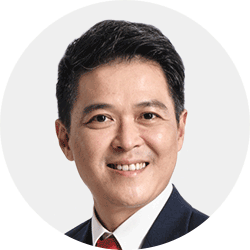
ASSOCIATE PROFESSOR LIM YEE WEI
NUS Saw Swee Hock School of Public Health & Yong Loo Lin School of Medicine National University of Singapore
Professor Lim is an Associate Professor and health policy researcher at the NUS Saw Swee Hock School of Public Health. He has led the NUS Improvement of Healthcare in Asia (NI...
Testimonials
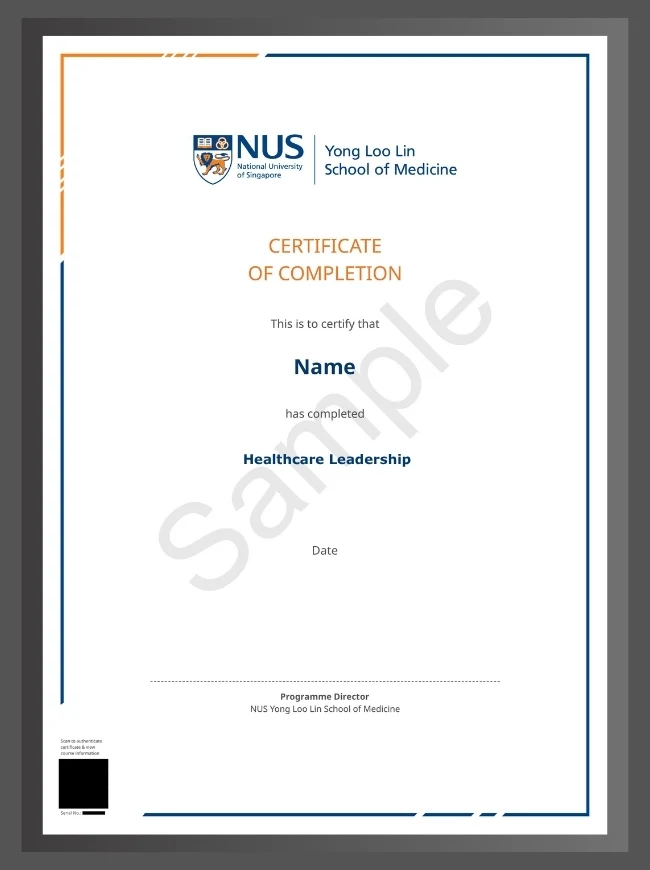
Certificate
Upon successful completion of the Programme, participants will be awarded a verified digital certificate by NUS Yong Loo Lin School of Medicine.
All certificate images are for illustrative purposes only and may be subject to change at the discretion of NUS Yong Loo Lin School of Medicine.
The Learning Experience
What is it like to learn with the learning collaborator, Emeritus?
More than 300,000 professionals globally, across 200 countries, have chosen to advance their skills with Emeritus and its educational learning partners. In fact, 90 percent of the respondents of a recent survey across all our programs said that their learning outcomes were met or exceeded. All the contents of the course would be made available to students at the commencement of the course. However, to ensure the program delivers the desired learning outcomes, the students may appoint Emeritus to manage the delivery of the program in a cohort-based manner during the course period the cost of which is already included in the overall Course fee of the course.
A dedicated program support team is available 7 days a week to answer questions about the learning platform, technical issues, or anything else that may affect your learning experience.
FAQs
What is the focus of the Healthcare Leadership programme?
This healthcare leadership course will equip professionals with the skills to drive transformation in healthcare organisations. It covers key areas such as communication, change management, team building, diversity, and decision-making strategies tailored for healthcare leadership and management courses.
Who should enrol in this healthcare leadership programme?
This programme is ideal for professionals in healthcare management, hospital administration, and related fields. It suits individuals aspiring to lead within healthcare leadership programs, health management courses, or those transitioning into healthcare leadership roles.
What topics are covered in the curriculum?
The curriculum includes modules on transformational leadership, managing conflict, stakeholder engagement, equity and inclusion, and coaching talent in healthcare settings. In a capstone project, participants will apply their knowledge to a real-world healthcare issue.
How does this programme compare to other leadership courses?
Unlike general leadership courses online, this programme focuses exclusively on leadership and management in healthcare courses, integrating real-world examples and healthcare-specific case studies. It also includes tools such as the Multifactor Leadership Questionnaire (MLQ) for self-assessment.
How are classes conducted?
The course is offered online with asynchronous learning (100+ video lectures) and three live sessions led by NUS faculty. Participants engage with practical case studies and collaborate through discussion boards, making it one of the best healthcare leadership courses online.
What practical tools will I gain during the programme?
Participants will use the MLQ tool to evaluate and improve their leadership style. They will also learn frameworks for decision-making, team development, and communication strategies relevant to healthcare management certification programmes.
What is the weekly time commitment?
The programme requires 4–6 hours per week over 12 weeks, making it manageable for professionals pursuing leadership certification online while working full-time.
Are flexible payment options available?
Yes, flexible payment plans are offered. Discounts for early registration and group enrolment make this healthcare leadership certification accessible to a broader audience. The programme fee is US$2,200.
Are there opportunities to network with other participants?
The programme facilitates interaction through live sessions and discussion boards, enabling participants to connect with peers and professionals across healthcare leadership degree programmes and related fields.
What are the admission requirements?
Open to graduates or diploma holders, the programme welcomes professionals with diverse experiences, from newly appointed managers to seasoned leaders in healthcare and related industries.
How long will participants have access to learning materials?
Participants will retain access to learning materials and session recordings for a specified duration post-programme completion, allowing for continued development.
What makes this programme unique?
Offered by NUS Yong Loo Lin School of Medicine, the course combines practical insights with academic rigour, focusing on the unique challenges of healthcare leadership and management courses. It prepares participants for real-world leadership scenarios through case studies and hands-on projects.
What certification will I receive upon completion?
Participants who meet attendance and assessment criteria will earn a verified digital certificate from NUS Yong Loo Lin School of Medicine, showcasing their leadership expertise.
Can this programme help advance my career?
Yes, this programme equips participants with skills to take on leadership roles in healthcare, foster organisational growth, and drive impactful change across healthcare settings.
Early registrations are encouraged. Seats fill up quickly!
Flexible payment options available.
Starts On