

AI for Healthcare
Round Application Deadline
Upcoming deadline: Invalid liquid data.
What will this Programme do for you?
Describe the fundamentals of biomedical informatics and digital transformation
Explain the key aspects of managing the life-cycle of data
Define the key AI terminologies and identify the opportunities of integrating deep learning in healthcare AI
Recognise the role of AI in drug discovery, development and administration
Examine the use of AI in optimising treatment for populations and personalised medicine
Analyse the impact of AI on quality of care and operations in healthcare
Explain the implementation of strategies and frameworks for AI in healthcare workflows
Describe the importance and implementation of Cloud technologies and Generative AI in healthcare operations
Create an executive summary of an AI implementation/improvement plan for your organisation
Programme Highlights

13 live webinars from renowned NUS faculty and industry practitioners.

Assignments

Discussion Boards

Real-World Case Analysis

The program includes latest topics such as Generative AI, Hybrid Clouds, and Digital Transformation in Healthcare

No prior AI knowledge is needed.
Note: The programme highlights mentioned above are subject to change based on faculty availability and the desired outcomes of the programme.
**Assignments will be graded by industry practitioners who are available to support participants in their learning journey, and/or by the Emeritus grading team. The final number of quizzes, assignments, and discussions will be confirmed closer to the start of the programme.
Case Studies
The State of Artificial Intelligence-Based FDA-Approved Medical Devices and Algorithms: An Online Database
Project IDentif.AI: Harnessing Artificial Intelligence to Rapidly Optimize Combination Therapy Development for Infectious Disease Intervention
Addressing COVID-19 Drug Development With Artificial Intelligence

AIDAN and AI-LIN vs. Vinny the Virus
Big Data and Machine Learning Algorithms for Healthcare Delivery
AI-Assisted Decision-Making in Healthcare
Capturing Feature-Level Irregularity in Disease Progression Modelling
Emergency Call Center AI Assistant
Programme Modules
Module 1: Introduction to Digital Transformation in Healthcare
Digital Transformation Overview
Current Landscape
Module 2: Biomedical Informatics Fundamentals Biomedical Informatics Data Fundamentals
Biomedical Informatics for Solving Problems
Types of Data
Sources of Data: Healthcare System
Relational Data Model
Structured Query Language (SQL)
Data Interoperability and Standards
Module 3: Managing the Life Cycle of Data
Data Repository
Data Privacy
Data Errors and Measures to Improve Data Quality
Data Transformation
Data Management
Module 4: Introduction to Machine Learning in Healthcare
Definition of AI
Definition of Machine Learning
A Brief Modern History of AI
Neurons and Neural Networks
Perceptron
Activation Functions
How AI Learns: Gradient Descent
Examples of Deep Neural Networks in Healthcare
Module 5: Deep Neural Network for Healthcare AI
Convolutional Neural Networks
The Digital Mammogram Case Study: from Research to Actual Deployment
Introduction to Generative AI
Generative AI in Healthcare
Module 6: Use of Hybrid Clouds in Healthcare
AI-enhanced Future of Healthcare Administrative Task Management
Healthcare Cloud Strategy using AWS
Healthcare Cloud Strategy using MS Azure
Healthcare Cloud Strategy using Google Health
Module 7: Role of AI in Drug Discovery, Development and Administration
Challenges of Drug Discovery and Development
Innovations in Drug Discovery, Development, and Diagnostics
AI in Drug Innovation Continuum
Bridging Early Discovery with Commercialisation
Module 8: Treatment Optimisation for Populations and Personalised Medicine
The Evolution of Technology in Healthcare
Rethinking Drug Development Using AI
Operationalising AI in Healthcare
Module 9: AI Development in Clinical Practice
Clinical AI Development Process
Challenges in Developing AI Tools
Architecture for AI Development in Clinical Practice
Module 10: Implementing AI in Clinical Practice
Production Deployment in Clinical AI
Ethics and Regulatory Considerations of Clinical AI
AI Implementation and Success in Healthcare
AI Patient Diagnosis and Monitoring Techniques
AI and Wearable Tech
LLMs in Healthcare Operations
AI in Radiotherapy Treatment Planning
Why Enrol for the Programme?
Artificial intelligence (AI) technologies are revolutionising nearly every aspect of healthcare. From data management to drug discovery and development to clinical practice and patient care, the innovations of AI continue to optimise and advance medical services. By understanding the impact of current and emerging AI technologies—including global trends and regulatory constraints—healthcare professionals can drive decision-making, elevate patient care, and improve profitability and performance. Whether you want to gain the knowledge to invest in AI projects that can move healthcare research ahead faster and with greater predictability, design secure solutions for patients and customers, or develop enhanced products related to medical services, this programme can put you on the path to make a real difference within—and beyond—your organisation.
Past Participant Profiles
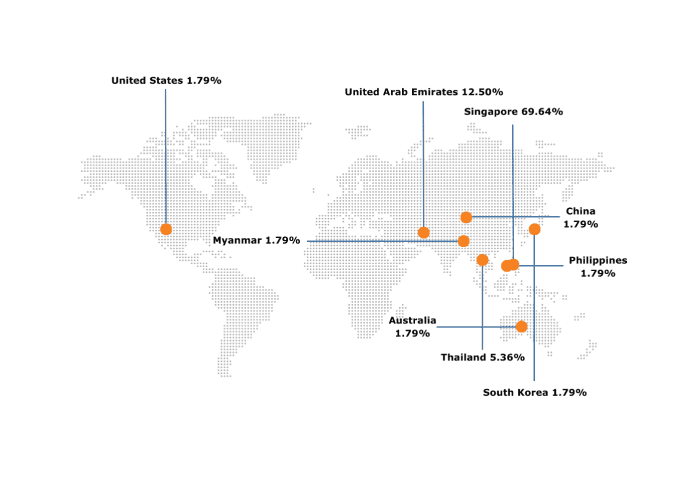
Countries
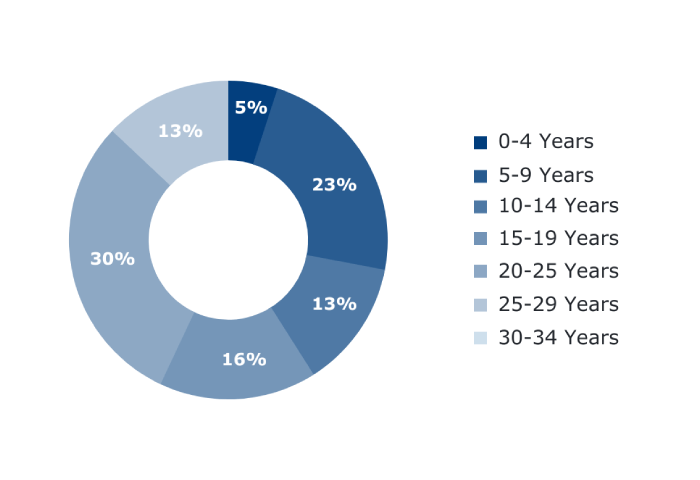
Work Experience
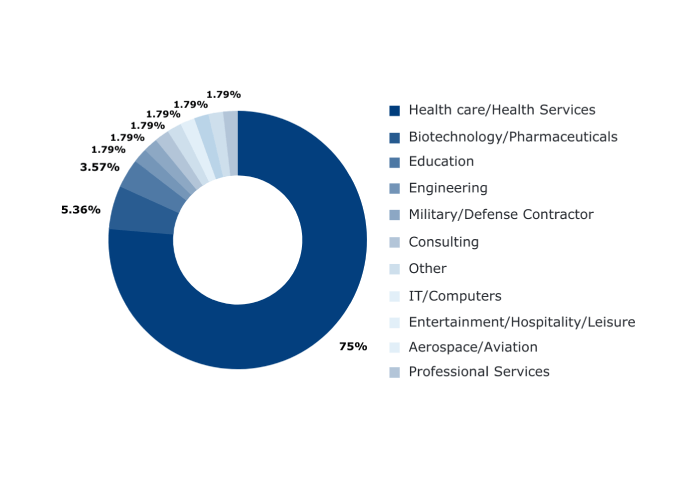
Industries
Who is this Programme for?
Representative roles and industries that can benefit include:
- Technology-driven sectors where AI applications are critical, including healthcare, medical services, medical devices, pharmaceuticals, biotechnology, edtech, IT, real estate, and telecommunications
- Doctors, individual practitioners and other healthcare professionals
- CEO, CIO, chairman, director, associate director, senior director of health care, pharmaceuticals, medical devices, information technology, and other relevant industries
- General manager, product manager, marketing manager, account manager, operations manager, project manager of healthcare, biotechnology, edtech, and medical devices
- Founder, co-founder of healthcare, medical services, and pharmaceutical industries
56%
50%
$88.26
*The schedule of live sessions and profile of Industry experts is subject to change and confirmation will be provided post programme start.
Programme Faculty
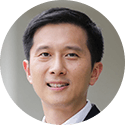
PROFESSOR NGIAM KEE YUAN
Faculty, NUS Yong Loo Lin School of Medicine
Professor Ngiam is Senior Consultant at the Division of General Surgery at the National University Hospital (NUH) who specialises in thyroid and endocrine surgical disorders. ...

PROFESSOR DEAN HO
Faculty, NUS Yong Loo Lin School of Medicine
Professor Dean Ho is Provost’s Chair Professor, Director of The N.1 Institute for Health (N.1), Director of the Institute for Digital Medicine (WisDM), and Head of the Departm...
DR FENG MENGLING
Faculty, NUS Yong Loo Lin School of Medicine
Dr Feng is currently the Assistant Director of Research at the Institute for Data Science, National University of Singapore. He also serves as the Senior Assistant Director of...
DR KENNETH BAN
Faculty, NUS Yong Loo Lin School of Medicine
Dr Ban obtained his BSc (Hons) in Biochemistry and MBBS degrees from NUS and a PhD in Cancer Biology from Stanford University. He completed his postdoctoral training in mouse ...
Note: Programme Faculty for the live sessions might change due to unavoidable circumstances, and revised details will be shared closer to the programme start date.
Past participants of Emeritus work at
Note: *All product and company names are trademarks or registered trademarks of their respective holders. Use of them does not imply any affiliation with or endorsement by them.
Testimonials
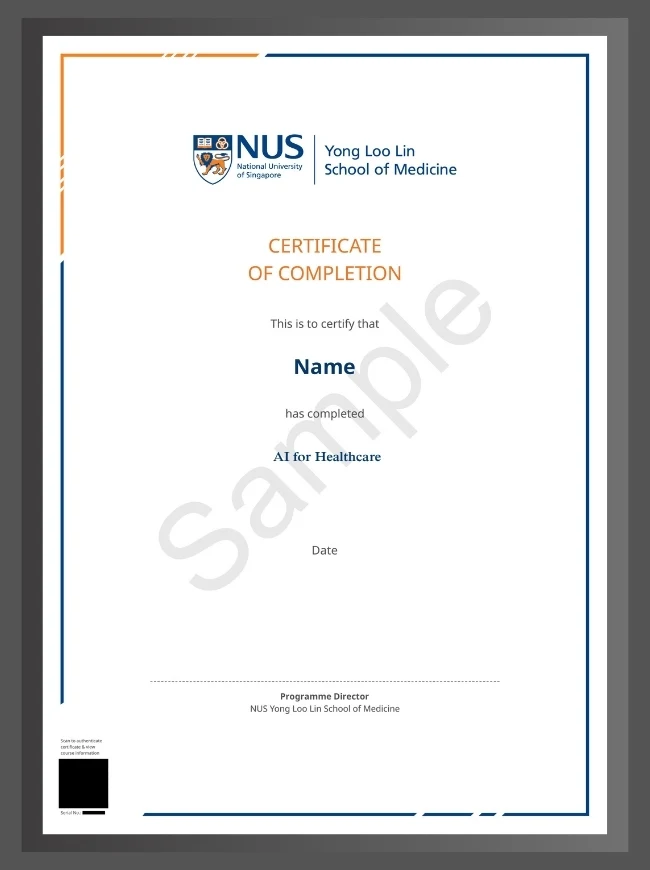
Certificate
Participants who successfully complete the programme and meet the requisite 65% minimum attendance criteria will be awarded a verified digital certificate by NUS Yong Loo Lin School of Medicine.
Note: All certificate images are for illustrative purposes only and may be subject to change at the discretion of the NUS Yong Loo Lin School of Medicine.
Emeritus Career Services
Stepping into a business leadership career requires a variety of job-ready skills. Below given services are provided by Emeritus, our learning collaborator for this program. The primary goal is to give you the skills needed to succeed in your career; however, job placement is not guaranteed.
Emeritus provides the following career preparation services:
Resume building videos
Interview preparation videos
Linkedln profile building videos
Interview guidebooks
Glossary of resume templates
Please note:
NUS or Emeritus do not promise or guarantee a job or progression in your current job. Career Services is only offered as a service that empowers you to manage your career proactively. The Career Services mentioned here are offered by Emeritus. NUS is not involved in any way and makes no commitments regarding the Career Services mentioned here
The Learning Experience
What is it like to learn with the learning collaborator, Emeritus?
More than 300,000 professionals globally, across 200 countries, have chosen to advance their skills with Emeritus and its educational learning partners. In fact, 90 percent of the respondents of a recent survey across all our programs said that their learning outcomes were met or exceeded. All the contents of the course would be made available to students at the commencement of the course. However, to ensure the program delivers the desired learning outcomes, the students may appoint Emeritus to manage the delivery of the program in a cohort-based manner during the course period the cost of which is already included in the overall Course fee of the course.
A dedicated program support team is available 7 days a week to answer questions about the learning platform, technical issues, or anything else that may affect your learning experience.
FAQs
What is the focus of the AI for Healthcare programme?
This programme explores the transformative applications of artificial intelligence and Generative AI in healthcare. Participants learn how AI technologies can optimise clinical practice, drug discovery, personalised medicine, and operational workflows.
Who should enrol in this healthcare AI course?
Designed for professionals with medical or non-medical backgrounds, this artificial intelligence course is ideal for doctors, researchers, healthcare executives, and individuals in technology-driven sectors like pharmaceuticals, biotechnology, and IT.
What topics are covered in the curriculum?
Topics include machine learning in healthcare, clinical AI development, deep neural networks, wearable tech, AI applications in healthcare, hybrid cloud strategies, and frameworks for AI deployment in clinical settings.
How does this programme compare to other AI courses online?
Unlike general AI programs, this AI for Healthcare course focuses on healthcare-specific challenges and solutions. Modules cover innovations such as Generative AI in drug discovery, radiotherapy planning, and patient monitoring systems.
How are classes conducted?
The programme features live online sessions, complemented by assignments, real-world case studies, and discussion boards. Sessions are delivered by NUS Medicine faculty and industry practitioners, ensuring an interactive learning experience.
What hands-on experience will participants gain?
Through practical case studies, learners will apply AI in medicine and healthcare to tackle challenges such as disease progression modelling, drug development, and designing secure solutions for patient care.
What is the weekly time commitment?
The programme requires 6–8 hours per week over a 13-week period, offering flexibility for working professionals seeking to learn artificial intelligence and its healthcare applications.
Are flexible payment options available?
Yes, participants can select payment plans to manage costs. Early enrolment discounts and group pricing are available, with a programme fee of US$2,500.
Are there networking opportunities?
Participants can connect with global peers and industry leaders during live sessions, discussion boards, and case study collaborations, fostering valuable relationships within healthcare AI courses.
What are the admission requirements?
Open to all graduates and diploma holders, the programme welcomes beginners and experienced professionals. No prior knowledge of AI in healthcare is required.
How long will participants retain access to learning materials?
Learners will have post-programme access to course materials for a specified period, allowing them to revisit content for continued learning and practice.
What makes this programme unique?
Offered by NUS Medicine, ranked among the top global institutions, the programme combines healthcare expertise with AI innovation. Cutting-edge modules such as Generative AI and hybrid cloud integration provide a competitive advantage in the healthcare industry.
What certification will I receive upon completion?
Participants who meet the requisite attendance criteria will earn a verified digital certificate from NUS Yong Loo Lin School of Medicine, validating their proficiency in leveraging AI for healthcare advancements.
Can this programme help advance my career?
Absolutely. This course equips learners with the expertise to lead AI-driven healthcare initiatives, opening doors to roles in clinical research, technology leadership, and healthcare innovation.
Early registrations are encouraged. Seats fill up quickly!
Flexible payment options available.
Starts On